|
|
|
|
|
The Ming Voyages(Travellers | Cities | Routes | Trade Goods | Themes)
In the early 15th century, China launched a series of
seven major maritime expeditions that sailed from Nanjing, then the
Ming dynasty capital, to India and beyond. Emperor Yongle (r. 1403-1424)
was the inspiration and mastermind behind these expeditions, and he
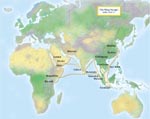
appointed the eunuch Zheng He in command. The Seven Major VoyagesThe dates of the seven major expeditions are as follows: The first three voyages travelled as far as Calicut on the west coast of India. The fourth ventured beyond India to Hormuz, and the last three expeditions journeyed all the way to the Arabian Peninsula and the east coast of Africa. Extended SummaryFrom 1405 to 1433, the Ming imperial court eunuch Zheng He (Cheng Ho) commanded seven maritime expeditions which sailed from China southward and westward along the coast, via the South China Sea, to Java, Sumatra, and Malacca. They then sailed across the Indian Ocean to Ceylon, Calicut, and Cochin in India. The later expeditions journeyed even further westward, reaching Aden, Hormuz, and Jiddah, from which seven Chinese Muslims made a pilgrimage to Makkah (Mecca). The expeditions visited approximately 30 foreign countries, with some of the ships even touching on the eastern coast of Africa, and leaving behind a genetic legacy - resulting from a shipwreck - a village on the coast of Africa whose inhabitants claim Chinese ancestry. This was the largest fleet ever to have sailed this far, not only in Chinese history but in that of the entire world. Moreover, it remained the largest one to sail the earth's oceans until World War I. The fleet, which sailed 80 years before Vasco Da Gama reached India in 1498, consisted of approximately 63 large "treasure-ships" (whose size is now hotly debated), and hundreds of small ones. Each voyage accommodated nearly 28,000 people. The inspiration behind these voyages was Emperor Yongle, who reigned as the third emperor of the Ming from 1403 to 1424. Scholars speculate about Yongle's reasons for launching these expeditions: were they chiefly for diplomatic, military, or economic, or other purposes? Whatever his motivation, the expeditions - which were completed under a subsequent emperor, Xuande (r. 1426-1435) -- gave rise to numerous foreign tribute missions to China during the Ming dynasty. One estimate is that there were 67 such missions. These in turn led to the establishment of official foreign relations between China and at least 16 countries from Java to the Gulf. In addition, the voyages opened the way for centuries of unofficial trade, overseas settlements, and the spread of Chinese culture and products to other regions of the world. They also introduced many new foreign goods, animals, and curiosities into China. Largely due to these voyages, China from the early 15th century forward became inextricably part of the wider world, not only geographically but also economically. One the most striking of foreign imports was a giraffe from Bengal (originally from Malindi) in 1414. The painter and calligrapher Shen Du made a magnificient painting of this giraffe. Chinese officials presented the animal to the Emperor calling it a qilin (an auspicious beast similar to our unicorn - really a giraffe), and claiming that its arrival on Chinese soil was an auspicious sign for the monarch's reign. There has been much speculation about the reason why these expeditions were suddenly stopped after 1433. Not only did the Chinese government refuse to authorize future official naval expeditions on this scale, but some government bureaucrats consciously burned the archives concerning these voyages, and thus attempted to erase all memory of them. Perhaps because officials regretted the huge expenditure of the empire's funds on seemingly frivolous, extravagant luxuries, at a time when the people at home faced natural disasters and domestic crises, the regime turned inward, forbidding the common people from sailing in large ships on the high seas. From disuse, shipping and shipbuilding technology was nearly forgotten. And China, which was well ahead of the West technologically, fell steadily behind. Three men served on these expeditions and wrote descriptions of the countries they visited that are still extant. These deserve to be more widely known and extensively studied. The three travellers were Ma Huan, Fei Xin, and Gong Zhen. The accounts of the first two have been translated, but that of the third has not, though they duplicate each other to some extent. Another important resource which survives is the Mao Kun map, a map that probably bears some relation to the navigation map or maps used on the voyages. There are other types of evidence as well, including inscriptions on stone monuments left along the journeys, archaeological finds of ships and other artefacts, including early Ming porcelain found on the east coast of Africa, and so forth. We hope you will enjoy exploring this important episode not only in Chinese history, but in the history of the entire world.
|
The Ming Voyages |