|
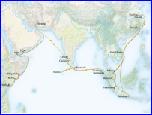
Visited: Java, Calicut, Hormuz, Aden, Mogadishu,
Brava.
Highlights: This voyage went as far as the
east coast of Africa. The Chinese fleet was compelled to make a
display of military force at Mogadishu and La'sa.
The avowed object of the expedition was to escort
back to their respective countries the ambassadors (or merchant-ambassadors)
from 19 kingdoms who had arrived on 19 Nov. 1416, and to present
gifts to their rulers. These kingdoms included: Champa, Pahang,
Java, Palembang, Malacca, Semudera, Lambri, Ceylon, the Maldive
Islands, Cochin, Calicut, Hormuz, La'sa, Aden, Mogadishu, Brava,
and Malindi.
On the return voyage, they also brought additional
foreign envoys back to China from various foreign countries. During
the 8th month (from 21 August to 19 September, 1419), a large number
of these foreign envoys were received at the Ming imperial court
bearing tribute.
Tribute: The Changle inscription describes
the various items presented to the Chinese throne by each country,
during the 8th month of 1419: "The country of Hormuz presented
lions, leopards with gold spots, and large western horses. The country
of Aden presented qilin of which the native name is zulafa (giraffe),
as well as the long-horned animal maha (oryx). The country of Mogadishu
presented huafulu (striped zebras), as well as lions. The country
of Brava presented camels which run one thousand li as well as camel-birds
(ostriches). The countries of Java and Calicut presented the animal
called miligao. They all vied in presenting the marvellous objects
preserved in the mountains or hidden in the seas and the beautiful
treasures buried in the sand or deposited on the shores. Some sent
a maternal uncle of the king, others a paternal uncle or a younger
brother of the king in order to present a letter of homage written
on goldleaf, as well as tribute."
Of these, the most notable were the giraffe, painted
by the Chinese artist Shen Du, and the ostrich, lauded in a long
descriptive poem (or fu, "rhymeprose") which was
composed by the scholar Jin Youzi. This poem aptly portrays the
sensation caused by these exotic animals in the Chinese court.
Sources
J. V. G. Mills, Ying-yai Sheng-lan: 'The Overall Survey of the
Ocean's Shores' [1433], Translated from the Chinese text ed. by
Feng Ch'eng-chün. Hakluyt Society, extra series, no. 42.
(Cambridge, England: Cambridge University Press, 1970); J. J. L.
Duyvendak, "The True Dates of the Chinese Maritime Expedition
in the Early 15th century", T'oung Pao 34 (1938), pp.
341-412.
|
|