|
Officials on Board: Zheng He, Ma Huan (his first voyage,
acting as interpreter)
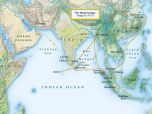
The Fleet: 63 ships; 28,560 men.
Visited: Champa, Kelantan, Pahang, Java, Palembang, Malacca,
Aru, Semudera, Lambri, Ceylon, Kayal, Maldive Islands, Cochin, Calicut,
Hormuz, Bila, and Sunla. A branch expedition sailed to Bengal.
Tribute: In the year of their return (1415), according the Liujiajiang
inscription, the king of the country of Malacca came in person,
with his wife and son, to present tribute.
Highlight: According to the Liujiajiang inscription, the
king of Semudera , Sultan Zain Al-'Abidin, had sent an envoy to
the Chinese emperor to lodge a complain against a usurper, Sekandar,
who was marauding and invading his country, and to request China's
assistance against him. Zheng He received imperial instructions
to lead forces against the usurper and restore the rightful king.
The Liujiajiang inscription says: "Approaching with the official
troops under our command, we have exterminated and arrested (the
rebels), and silently aided by the divine power, we thereupon captured
the false king alive. In the thirteenth year (1415) on our return
he was presented (to the Emperor as a prisoner)."
Zheng He's troops had pursued him to Lambri, captured him (with
his wife and child), and taken them to China. Upon arrival in China,
the prisoner was offered to the emperor at the gate of the palace,
and later executed.
Sources
J. V. G. Mills, Ying-yai Sheng-lan: 'The Overall Survey of the
Ocean's Shores' [1433], translated from the Chinese text ed. by
Feng Ch'eng-chün. Hakluyt Society, extra series, no. 42.
(Cambridge, England: Cambridge University Press, 1970); J. J. L.
Duyvendak, "The True Dates of the Chinese Maritime Expedition
in the Early 15th century", T'oung Pao 34 (1938), pp.
341-412.
|
|