|
|
|
|
|
The Ming Voyages -- The Third Voyage, 1409-1411
Evidence for the Third VoyageThe Order for the Third Voyage
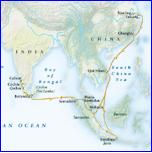
About the Third VoyageImperial Order: The Imperial edict ordering the expedition was dated the 1st month of Yongle 7 (16 January - 14 February, 1409), and was directed to Zheng He, Wang Jinghong, and Hou Xian. This took place while the second expedition was still going on. Departed: 9th month, Yongle 7 (9 October - 6 November, 1409), sailing from Liujiajiang Returned: Yongle 9 (6 July, 1411)
Officials on Board: Zheng He was the leader of this expedition, and was accompanied by Wang Jinghong, Hou Xian, and Fei Xin. The Fleet: 48 ships (hoisting 12 sails); and 30,000 government troops. Places Visited: Champa, Java, Malacca, Semudera (Samudra), Poulo Sembilan, Ceylon, Quilon, Calicut, Cochin, and Siam. Tribute: Chinese officials presented gifts to a Buddhist temple in Ceylon. Highlights: An inscription, composed in China before this voyage, and dated 15 February 1409, was inscribed on a tablet and erected in Ceylon. Written in three languages (Chinese, Tamil, and Persian), the inscription commemorated the gifts that the Chinese envoys presented, in the name of the emperor, to a Buddhist temple. It also expressed gratitude to the Buddha of Ceylon for the safe return to China of the first expedition. The principal incident of the voyage happened in Ceylon on the return voyage in 1411. A violent conflict broke out between Zheng He's forces and those of the Sinhalese king Alagakkonara (Yalieruo'nai'er), ruler of the Rayigama kingdom near Columbo. The Chinese inscriptions say that the king "was guilty of a gross lack of respect and plotted against the fleet". They fought several battles, and Zheng He's forces were victorious. The Chinese officials captured the king, along with his wife, children, and principal functionaries, and took them to China. When they presented their prisoner to the emperor, he pardoned the king and allowed him and his family to return home. Zheng He was ordered to elevate Malacca to the rank of a "kingdom" on this voyage.
|
The Third Voyage
|