|
|
|
|
|
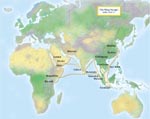
An Introduction to the Ming VoyagesIn 1403, soon after his accession to the throne, the Ming emperor Yongle (Yung-lo, r. 1403-1424) issued an edict for the preparation of a series of long-distance maritime expeditions. This edict, calling for the immediate construction of 250 ocean-going ships, inaugurated an ambitious programme of overseas travel, trade, exploration and diplomatic contact that was to flourish for nearly 30 years, and lay the foundation for intercultural contact between China and numerous states in the Indian Ocean, on the coast of the Arabian peninsula, and East Africa. The reasons why Emperor Yongle began this ambitious programme are still debated among scholars, and the question is by no means resolved. However, there is no doubt that seven major maritime expeditions set out from Nanjing between 1405 and 1433 for distant places along the sea-route from China through the Strait of Malacca, across the Bay of Bengal to Ceylon and southern India, to the important trade emporium of Calicut on the west coast of India and beyond. The first three expeditions stopped in Calicut and went no further, but the fourth went on to Hormuz, and the last three sailed to the Arabian peninsula and the east coast of Africa. There is no evidence that they went any further. To head these expeditions and command the fleet, Yongle appointed the trusted eunuch Zheng He, who had served him loyally in a military capacity while Yongle was still Prince of Yan. From 1403 to 1405 Zheng He orchestrated the preparations, and the first expedition set off in the autumn of 1405. The edict ordering the launch of the expeditions was issued on the jimao day of the sixth month in the third year of Yongle, or 11 July, 1405. (Ming Shilu, 35.6a) This first expedition set the general pattern for the other six. It set sail in the early autumn from the Treasure Shipyard in the northwest corner of Nanjing, which was situated on the Yangzi (Yangtze) river. The fleet then proceeded eastward along the Yangzi to Taicang, at the mouth of a small river called Liujiajiang that flows into the Yangzi as it meets the sea. From there, Zheng He's ships sailed southward along the coast of China to Fujian province, anchoring at the port of Changle. This voyage took about one month, but the fleet had to wait there, often for a month or more, for the winter monsoon, which would facilitate travel to the south and west. After leaving the Chinese coast in December or January, the fleet first sailed south to Champa, and then to Java, and Palembang on the coast of Sumatra. It then headed westward through the Strait of Malacca to Melaka itself. It made several more stops on Sumatra at Aru (Deli), Samudra-Pasai, Nagur, Lide, and Lambri before crossing the Bay of Bengal and reached Ceylon (present-day Sri Lanka). Then it proceeded around the tip of the Indian peninsula up the western coast to Quilon, Cochin, and Calicut. This was the furthest point reached by the first three expeditions. Calicut was a major trade emporium in the 15th century, and when the Chinese ships arrived there, they encountered Arab traders as well as those from India. They had probably met Arabs in the other Indian Ocean ports as well, but Calicut was truly a huge centre. It was probably the previous encounters with Arab traders that motivated the commanders of the Chinese expeditions to plan to sail further west on the fourth journey, and to visit Arabic-speaking countries. On his return to China with the third expedition, Zheng He made special preparations for the fourth voyage, searching for an interpreter who could speak both Arabic and Persian. It was then that he encountered Ma Huan, a Muslim from the southern city of Guiji. Ma Huan accompanied Zheng He on the fourth expedition, which reached Hormuz, and on two subsequent voyages. He wrote one of the three extant accounts of the countries visited on the expeditions, The Overall Survey of the Ocean's Shores (Yingyai shenglan), which was the basis for J. V. G. Mills' translation and exhaustive study in 1970. It is one of the main primary sources for the study of the Ming voyages. The fifth and sixth voyages proceeded even further west, to the Arabian peninsula and the east coast of Africa. After the sixth expedition returned to China in 1422, there was a hiatus of nine years during which no voyages were launched. While a seventh expedition was being planned, Emperor Yongle, who had been the main motivating force behind the voyages, passed away in 1424 during a military campaign against the Mongols. His successor, Renzong, strongly opposed the expeditions, seeing them as a substantial drain on the treasury and burden on an already overtaxed population. Renzong put a complete stop to the expeditions as soon as he ascended the throne. However, this policy was soon reversed after Renzong became suddenly ill and died before his first year as emperor was out. He was succeeded in 1425 by Xuanzong, who more closely resembled Yongle in his willingness to engage in ambitious projects. Even so, it took until 1431 for the seventh expedition to be launched and this was the last to be sent out. The seventh expedition in some ways was the greatest expedition; it went the furthest distance, and may have been the largest in terms of personnel. In addition to visiting the ports along the coast of the Arabian peninsula, a portion of the Chinese fleet sailed into the Red Sea, anchored at Jeddah, disembarked, and made the pilgrimage to Makkah. While following the same general pattern, each of these voyages was a unique configuration of people, circumstances and events. You can follow the links to the seven voyages below to see how they were unique. In addition to the seven major expeditions, there were a number of minor, or 'side' expeditions. These side expeditions and other aspects of the voyages will be discussed in the next section of this article. NEXT -->
|
The Ming Voyages |