|
|
|
|
|
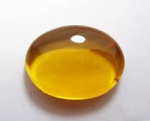
Amber[Travellers | Cities | Routes | Trade Goods | Themes] Amber is a fossil resin derived from the sap of various trees, particularly of the genus Pinus. It ranges in age from c.345 million years old (Carboniferous), for example that found in England, to as recent as 2 million years (Pleistocene) when it is derived from a wider range of botanical species. Both the age and the provenance of amber can often be determined, making it a useful indicator of trade routes. Amber occurs in many parts of the world, although the most famous deposits are those of the Baltic. Amber was traded from an early date for adornment, for its magical properties and as a medicine. Inclusions in amber shed light on plants and insects back to the Triassic. Amber has been found associated with man in dwelling caves since the Palaeolithic, often in places where it does not occur naturally. It is assumed that it was brought south by returning hunters and may represent a very early example of barter. Mesolithic pendants and sculptures in amber dating to 7000 B.C. have been found in Denmark and along the Baltic. By 3000 B.C., large hoards of worked amber (up to 13 000 beads together) appear in North East Europe, as well as at factory sites, where items were mass-produced, presumably for export. By about 1600 B.C., Baltic amber was reaching Mycenae and Egypt; and possibly Anatolia and Mesopotamia. Amber was traded down the great river systems, the Rhine, the Rhone, the Elbe and later the Po. A splendid amber cup holding a quarter litre was found in a tumulus at Hove on the South coast of England. It is dated to c.1500 B.C., but was probably local not imported. Homer mentions amber in the Odyssey and in about 600 B.C., the Greek philosopher, Thales of Miletus, commented on its power to attract seeds and other small objects when rubbed. The Greek name - electrum – thus gives us our word electricity. After this date, amber seems to have gone out of fashion in Greece, although it was appreciated by the Etruscans, who may have imported it via Trieste. In the Iron Age, about 700 B.C., a new route seems to have opened from the East Baltic via the Vistula to the Mediterranean and Black Sea Regions. The area near Salzburg (Hallstatt), Austria was important for its trade in salt and copper, and also amber. Another area where amber has been found in a human context since the Palaeolithic is Romania, where it occurs in the foothills of the Carpathians. From early times, Romania had an important trade in salt and gold and probably also amber. In Rome, amber seems to have been fashionable between 100 B.C. and 100 A.D., and was so expensive that Pliny comments: "the price of a small figure in it, however diminutive, exceeds that of a healthy slave." Three major hoards (2750 kg) found between Osiesk and the mouth of the Adriatic, indicate the route whereby amber was being traded south. Aquileia appears to have been the main processing centre. The naturalist, Pliny the Elder, wrote of the origins and properties of amber, as did Tacitus, the governor of Germany, who must have had first hand knowledge of how it was collected. Under the later Empire, amber seems to have become unfashionable and later still the Gothic invasions cut off the source of supply. Throughout history, there is some confusion as to what is meant by amber – Pliny’s "Indian amber" for example, was mostly probably a modern resin (copal), while in lists of trade goods it is often unclear whether fossil resin, incense or ambergris is in fact meant. With the advent of Christianity, amber may have fallen from favour because it was associated with pagan superstition. It was used in the magnificent Celtic broaches, but surprisingly little has been found among the Vikings, apart from the occasional "Thor’s hammer"pendant, and it seems to have been little used during the earlier Middle Ages. From the 13th century, the Baltic area came under the authority of the Teutonic knights, who allowed amber to be fished, but not worked, in their territories. This amber was largely marketed by the Jaski family of Danzig, while another major centre of manufacturing was Bruges. As the rosary became increasingly popular among Catholics, the amber was primarily used for beads, as well as carved figures and vessels Small amounts were also used to prepare a very superior varnish. Amber seems to have been known in China from at least the first century B.C. The earliest imports via Yunnan were probably from Upper Burma, where considerable quantities were mined. Burmese amber is brown or reddish, not bright and yellow like Baltic amber, which was imported from the early Middle Ages via Khurasan and, according to Chinese sources, Kashmir. Mention is also made of tribute amber from Japan before the year 1000. From the 16th century, amber was one of the trade goods carried east by both the Dutch and the Portuguese, but the origin is uncertain. It was much used in China for statues, bowls, snuff bottles, pendants and the 108-bead "Mandarin necklaces". Amber was also used for necklaces in the Islamic world. Ibn Iyas describes the Sultan Malik Ashraf at Cairo on the ‘Id al-Fitr, 1507, as dressed in white and gold, with "a necklace of amber beads." During the 16th-17th centuries, amber became very fashionable in Europe for the handles of knives and forks, caskets, gameboards, statues, etc. The Middle East and Central Asia imported amber as decoration for arms and saddlery, while in the Ottoman Empire, because of its supposedly disinfectant properties, amber was in great demand for the mouthpieces of hookahs. A similar fashion for amber mouth pieces for pipes and cigarette holders later spread to the West. A new source of amber – Sicily –began to be exploited in the 17th century. Amulets dated to before 1500 B.C. have been found, but the long hiatus suggests that the amber-bearing layers along the River Simeto were not exposed again until this late date. Sicilian amber is characterised by unusual colours, including purplish and violet tinges, and a very high degree of fluorescence. A new use was found for amber in the early 18th century, when Peter the Great of Russia bought amber mosaic panelling for an entire room from Berlin for one of his palaces. The amber room is now preserved at Tsarskoe Selo. By the 19th century, the Middle East and Iran were the largest market for European amber, much of it going to Mecca, where it was thought to be sold as a souvenir to pilgrims on the Hajj in the form of prayer beads. Armenians were generally the intermediaries in this trade. Amber, as well as being used for jewelry, was also believed from earliest times to be a powerful amulet and a cure for many illnesses. Pliny, writing in the 1st century A.D. summarises its virtues, which were again advocated by Culpeper in his Dispensatory, 1654. In China, it was used as a sedative, in Russia as a protective charm for nurses and children and in the U.S.A., as recently as the 1930s, it was used medicinally for convulsions. In many parts of the Muslim world, particularly the Arabian Peninsula and North Africa, but also in sub-Saharan Africa, especially to the west, nomad and country women still wear splendid silver necklaces enriched with enormous amber beads. These are combined with coral, carnelian and sometimes turquoise or blue faience, for decoration, but also to provide a powerful charm against the evil eye and generally to bring good luck. Amber being expensive, many of the beads are made of modern resin, sometimes combined with amber dust and often mixed with perfuming agents, such as ambergris. Recently, large quantities of amber have been exported
from the Dominican Republic, where it was first noted by Christopher
Columbus on his second voyage. Some of it dates back to 35 million
B.C., while some is to be classified as copal. Amber is also found
at numerous points in the U.S.A. and Central America. It was prized
by the Inuits of Alaska and was an important article of commerce
among the Aztecs and the Maya.
|
Amber |