|
|
|
|
|
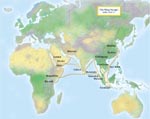
The Ming Voyages -- The Liujiajiang Inscription(Travellers | Cities | Routes | Trade Goods | Themes) In the sixth year of Xuande of the Ming dynasty (1431), the cyclical year xinhai, the first day of (the second) spring (month) (March 14th), the principal envoys, the Grand Eunuchs Zheng He and Wang Jinghong, the assistant-envoys, the Grand Eunuchs Zhu Liang, Chou Fu,[2] Hong Bao and Yang Zhen and the Senior Lesser Eunuch Zhang Da have erected an inscription as follows: The majestic miraculous power of the goddess the Celestial Spouse, to whom by Imperial command the title has been conferred of "Protector of the country and defender of the people whose miraculous power manifestly answers (prayers) and whose vast benevolence saves universally",[3] is widely spread over the great sea and her virtuous achievements have been recorded in a most honourable manner in the Bureau of Sacrificial Worship. From the time when we, Zheng He and his companions, at the beginning of the Yongle period, received the Imperial commission as envoys to the barbarians up till now, seven[4] voyages have taken place, and each time we have commanded several tens of thousand government soldiers and more than a hundred oceangoing vessels. Starting from T’ai-ts’ang and taking the sea we have by way of the countries of Zhancheng (Champa), Xianle (Siam), Guawa[5] (Java), Kezhi (Cochin) and Guli (Calicut) reached Hulumosi (Ormuz, Hormuz) and other countries of the western regions, more than three thousand[6] countries in all, traversing more than a hundred thousand li of immense waterspaces and beholding waves (gaping like the mouths of) whales, rising up to heaven, immense and (succeeding each other) endlessly. Now there were the drizzle of thick fogs, now steep windswept waves and in all those inconstant changes of the aspect of the ocean our sails, loftily unfurled like clouds, day and night continued their course, rapid like that of a star. Save by trusting in the divine power, how could we have found a tranquil crossing. When once it happened that we were in danger, as soon as we had pronounced the name of the goddess, the answer (to prayer) followed (swiftly) like an echo: suddenly there was a magic lantern in the mast and as soon as this miraculous light appeared the danger was becalmed.[7] Everyone on the fleet, set at rest, felt assured that there was nothing to fear. This is in general terms what the merit of the goddess has accomplished. On arriving in the outlying countries, those among the barbarian kings who were obstructing the "transforming influence" (of Chinese culture) and were disrespectful we captured alive, and brigands who gave themselves over to violence and plunder we exterminated. Consequently the sea route was purified and tranquillized and the natives, owing to this, were enabled quietly to pursue their avocations. All this is due to the aid of the goddess. Formerly we have already reported the merits of the goddess in a memorial and have requested of the throne that a palace be erected[8] at Nanking on the bank of the Dragon River where sacrificial worship is forever to be continued. We have respectfully received an imperial commemorative composition in order to glorify the miraculous favours, thus bestowing the highest praise.[9] However, wherever one goes there are places of residence for the miraculous power of the goddess. Thus the ‘temporary palace’ at Liujiajiang, built many years ago, has been repaired by us each time we have come hither. In the winter of the fifth year of Xuande (1430), having once more received a commission as envoys the barbarian countries, we have moored our ships at the foot of the shrine and the soldiers of the government army have respectfully and sincerely assisted at the rites and the sacrifices have been continuous. We have added new improvements to the buildings of the goddess which vastly surpass the old established usage and we have rebuilt the shrine of the "Younger Sister of the Qu Mountain"[10] behind the palace, and have replaced the statue of the goddess in the principal hall with a new beautiful statue. Officers and common soldiers all gladly hastened hither to worship and there were some who could not control themselves (with joy). Could this have been brought about otherwise than by the sense of gratitude for the merit of the goddess, felt in men’s hearts? Therefore we have written an inscription on stone and have moreover recorded the years and months of our voyages both going and returning in order to make these known forever. I. In the third year of Yongle (1405), commanding the fleet we have gone to Guli (Calicut) and other countries. At that time the pirate Chen Zuyi and his followers were assembled at Sanfoqi (Palembang) where they plundered the native merchants. We captured that leader alive and returned in the fifth year (1407). II. In the fifth year of Yongle (1407) commanding the fleet, we went to Gua[11]wa (Java), Guli (Calicut), Kezhi (Cochin), and Xianle (Siam). The kings of those countries all presented as tribute local products, and precious birds and (rare)[12] animals. We returned in the seventh year (1409). III. In the seventh year of Yongle (1409), commanding the fleet, we went to the countries (visited) before and took our route by the country of Xilanshan (Ceylon). Its king Yalie’ro’[13]nai’er (Alagakkonara) was guilty of a gross lack of respect and plotted against the fleet. Owing to the manifest answer (to prayer) of the divine power (the plot) was discovered an) thereupon that king was captured alive. In the ninth year (1411) on our return he was presented (to the throne as a prisoner); subsequently he received the Imperial favour of returning to his own country. IV. In the twelfth[14] year of Yongle (1414), commanding the fleet, we went to Hulu[15]mosi (Ormuz) and other countries. In the country of Sumendala (Samudra) the false king Suganla (*Sekandar) was marauding and invading his country. Its king had sent an envoy to the Palace Gates in order to lodge a complaint and to request assistance. Approaching with the official troops under our command, we have exterminated and arrested (the rebels), and silently aided by the divine power, we thereupon captured the false king alive. In the thirteenth year (1415) on our return he was presented (to the Emperor as a prisoner). In that year the king of the country of Manlajia (Malacca) came in person with[16] his wife and son to present tribute. V. In the fifteenth year of Yongle (1417) commanding the fleet we visited the western regions. The country of Hulumosi (Ormuz) presented lions, leopards with gold spots and western horses. The country of Adan (Aden) presented qilin of which the native name is zulafa (giraffe), as well as the longhorned animal maha (oryx). The country of Mugudushu (Mogadisho) presented huafulu ("striped" zebras) as well as lions. The country of Bulawa (Brawa) presented camels which run one thousand li as well as camel-birds (ostriches). The countries of Gua[17]wa (Java) and Guli (Calicut) presented the animal mi[18]ligao. All presented local products the like of which had never been heard of before and sent the maternal uncle[19] or the younger brother (of the king) to present a letter of homage written on goldleaf, as well as tribute. VI. In the nineteenth year of Yongle (1421), commanding the fleet we conducted the ambassadors from Hulumosi (Ormuz) and the other countries, who had been in attendance at the capital for a long time, back to their countries. The kings of all these countries presented local products as tribute even more than previously. VII. In the fifth year of Xuande (1430), starting once more for the barbarian (countries) in order to make known the imperial commands, the fleet has anchored at the foot of the shrine and recalling how previously we have on several occasions received the benefit of the protection of the divine intelligence we have hereupon inscribed a text on stone. Notes
SourceJ. J. L. Duyvendak, "The True Dates of the Chinese Maritime Expeditions in the Early Fifteenth Century", T'oung Pao 34 (1938), pp. 341-412; this inscription is translated on pp. 343-349.
|
The Ming Voyages |